
The Most Famous Bitcoin Maximalist on Earth Just Proved My Point
When the world's most famous Bitcoin maximalist pivots to stablecoins at the point of sale, the two-asset strategy stops being a theory and becomes a fact.
Jack Dorsey doesn’t like stablecoins. He’s said so publicly, repeatedly, and with the kind of conviction that only a true believer can muster. This is the man who once said that if he weren’t working on other projects, he would devote himself entirely to Bitcoin. The man who compared the Bitcoin white paper to poetry. The man who, when Facebook came calling about its Libra stablecoin project in 2019, the then-CEO of Twitter responded with two words: “Hell no.”
So when Dorsey recently announced that Block—his payments company, formerly Square—will be adding stablecoin support, the headline practically wrote itself. But for readers of this newsletter, the more important question isn’t what Dorsey said. It’s why the market forced him to say it.
And the answer validates everything I discussed in my new book, Make Your Wallet Your Bank.
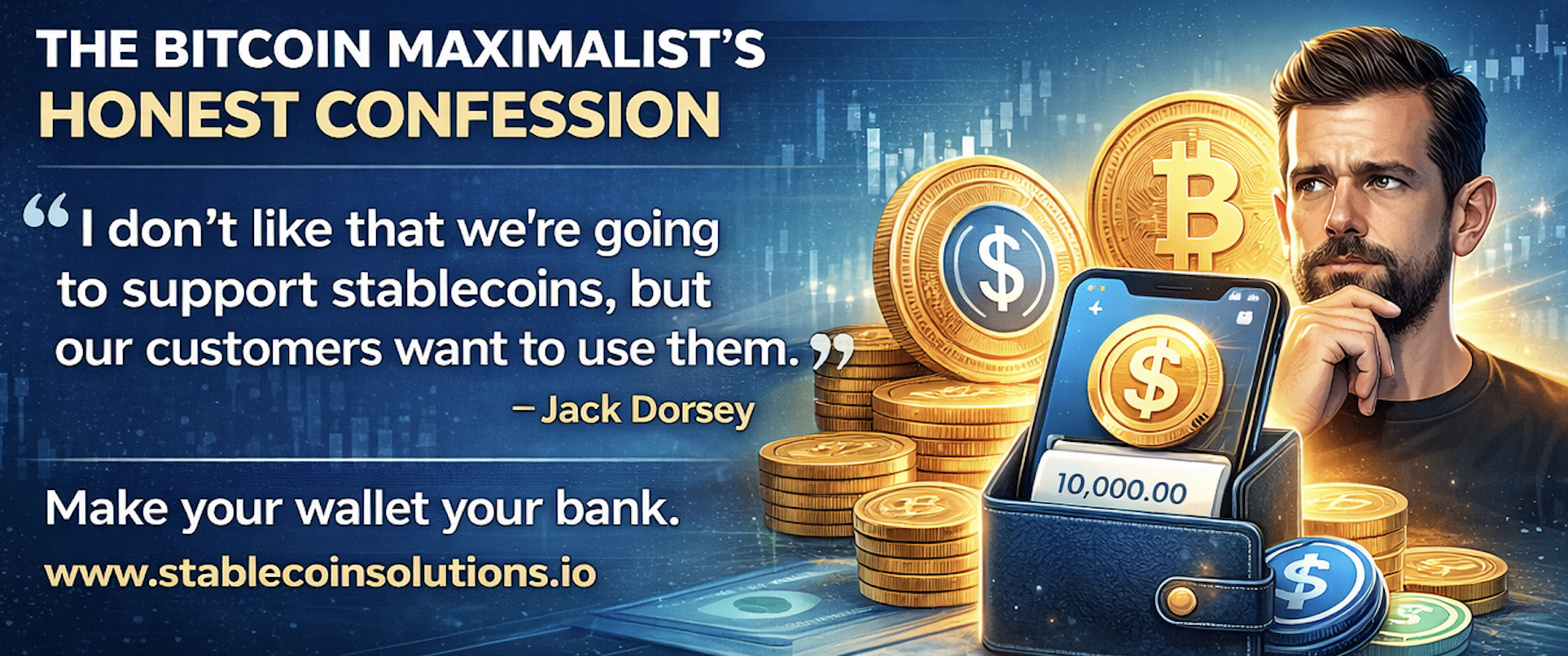
The Bitcoin Maximalist’s Honest Confession
Here is Dorsey’s quote, and it deserves to sit alone for a moment:
“I don’t like that we’re going to support stablecoins, but our customers want to use them.”
Strip away the corporate framing and you have a world-class payments operator telling you, in plain English, that Bitcoin cannot yet function alone as a payment layer at the merchant point of sale. Not for his customers. Not at scale. Not right now.
This isn’t a minor footnote. Block built its crypto strategy entirely around Bitcoin. The company integrated BTC buying and selling through Cash App starting in 2017. It funded Bitcoin and Lightning Network developers. It launched hardware wallets and modular mining rigs. It accumulated 8,888 BTC—currently worth north of $600 million—on its corporate balance sheet. If any company on earth was positioned to prove that Bitcoin-only works at the consumer payment layer, it was Block.
And Block just blinked.
What Bitcoin Gets Right (And What It Can’t Do Alone)
Let me be precise here, because this isn’t a Bitcoin hit piece. I love Bitcoin! The case for Bitcoin has never been stronger. As a store of value, as a hedge against currency debasement, as a long-term wealth preservation tool—Bitcoin is doing exactly what it was designed to do. Its fixed supply, its decentralization, its credible neutrality, these are features, not bugs, and they are why serious investors are stacking it for the long haul.
But here’s the problem Bitcoin maximalists keep running into at the checkout counter: the vast majority of merchants don’t accept it.
Not on Cash App. Not on Square terminals. Not at your grocery store, your landlord’s payment portal, or your insurance company’s billing system. The Lightning Network, for all its promise, has not achieved the merchant or consumer adoption necessary to function as a day-to-day spending layer. Bitcoin is digital gold—and gold, historically, is not what you hand the cashier.
Dorsey knows this. His customers told him. And rather than hold the ideological line at the cost of his business, he made the pragmatic call.
The Two-Asset Strategy Isn’t a Compromise. It’s the Architecture.
Make Your Wallet Your Bank is built on one core thesis: Spend in stables. Stack in sats. Make your wallet your bank.
The two-asset strategy isn’t a consolation prize for people who can’t fully commit to Bitcoin. It’s the correct architecture for the world we actually live in—not the world many wish we lived in.
Stablecoins solve the merchant adoption problem. A dollar-pegged stablecoin is a dollar, settled in seconds, on rails that don’t sleep on weekends or charge 2-3% interchange. That’s why Stripe, PayPal, and now Block are racing to integrate them. That’s why the stablecoin market has surged to $318 billion in total market capitalization. That’s why Cash App announced stablecoin support in November 2025, making them interoperable with customers’ existing USD cash balances.
The market isn’t waiting for merchant Bitcoin adoption to catch up. The market built a workaround—and that workaround is stablecoins.
Meanwhile, Bitcoin keeps doing what it does best: appreciating, preserving wealth, and protecting holders from the slow-motion debasement of fiat currencies. You hold your Bitcoin. You spend your stablecoins. These two functions are complementary, not competing.
The Gatekeeper Problem (And Why It Doesn’t Change the Math)
To his credit, Dorsey didn’t abandon his principles entirely. His concern about stablecoins is worth hearing: “I don’t think it’s wise to go from one gatekeeper to another.”
He’s not wrong about the risk. A dollar-pegged stablecoin is still a dollar controlled by someone—a reserve custodian, a regulated issuer, a government that can freeze your account or blacklist your wallet. The GENIUS Act is now the law of the land and it will bring stablecoins further into the regulatory perimeter. That’s a real trade-off, and serious people should think about it.
But Dorsey’s philosophical objection to stablecoins doesn’t change the commercial reality his own company just validated. Ideological purity doesn’t process payments. And for people living in fiat economies—paying rent, buying groceries, covering insurance premiums—the relevant question isn’t “is this optimally decentralized?” It’s “does this work?”
Stablecoins work. Bitcoin doesn’t yet, not at the point of sale, not at mass-market and not at scale. The two-asset strategy accounts for both.
What This Means for You
If the most committed Bitcoin company in the payments space just integrated stablecoins because the market demanded it, ask yourself what that tells you about where the puck is going.
Stripe built it. PayPal built it. Block built it. The GENIUS Act is moving it into reality. The architecture of the new financial system is not Bitcoin-or-stablecoins. It is Bitcoin and stablecoins—each doing what it does best, held together in a self-custodied wallet that you control.
That is exactly the wallet my book was written to help you build.
Jack Dorsey didn’t mean to confirm my thesis. But market reality has a way of forcing honest people to tell the truth.
Spend in stables. Stack in sats. Make your wallet your bank.