
Stablecoins Offer An Alternative to the Tollbooth Economy
The Toolboth Econmy:
Economists have used that term for years to describe how financialized systems extract fees at every chokepoint. But here’s what they left out: the tollbooth isn’t just on Wall Street. It’s sitting right inside your checking account, skimming from your paycheck before you ever see it. Because that’s exactly what’s happening every time your paycheck lands at a bank. Your bank pays you 0.07% on deposits while lending your money out at 7%… 8%… 20%+ on credit cards. Wire fees. Overdraft fees. Foreign transaction fees. Monthly maintenance fees. You’re paying rent to access your own money.
Your dollars sit in their ledger. On their terms. Under their control.
The tollbooth isn’t on the highway. It’s in your wallet.
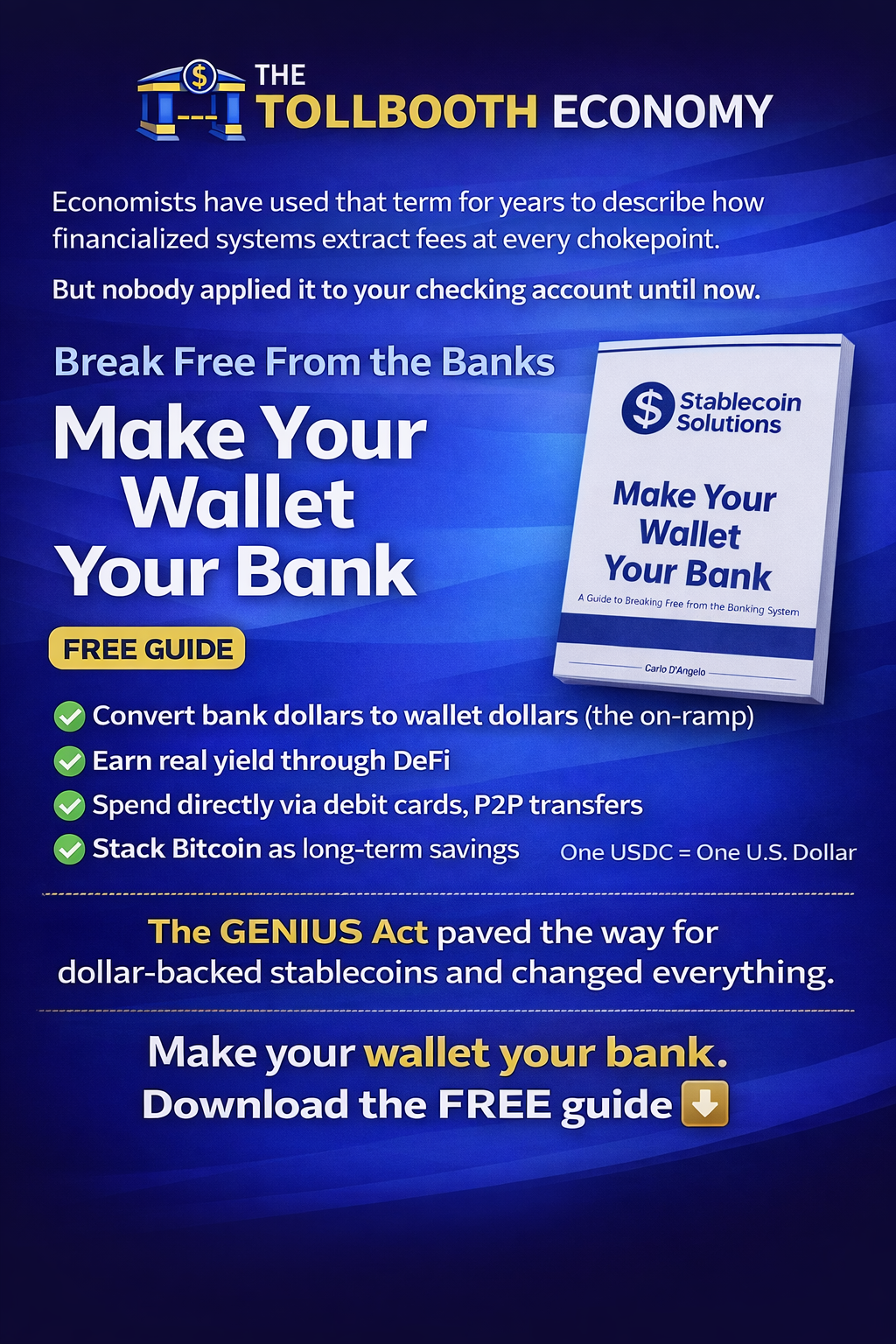
Here’s what changed.
The GENIUS Act just gave stablecoins—digital dollars that live in wallets you control—a soon-to-be fully federally regulated framework. For the first time in history, this isn’t a fringe experiment. It’s a recognized, regulated financial instrument with a legal foundation strong enough for consumers and small businesses to build on.
Once the GENIUS Act regulatory framework goes live, one USDC will be required under law to equal one U.S. dollar. No volatility. No 10% overnight swings. Just a dollar—except it lives in your wallet, not the bank’s database.
No bank can delay it. No bank can charge you rent to hold it. And, no bank can charge you outrageous fees to move it. Your money. In your wallet. And free to move on your terms.
Here’s the framework I lay out in Make Your Wallet Your Bank:
➡️ Convert bank dollars to wallet dollars (the on-ramp)
➡️ If you choose to, earn yield on those digital dollars through DeFi or on centralized crypto exchanges—the same type of yield banks pocket while paying you nothing
➡️ Spend directly via stablecoin-linked debit cards, merchant integrations, P2P transfers that settle in seconds
➡️ If you choose to, take the savings you earn on holding stablecoins and stack Bitcoin as your long-term savings layer—scarce, appreciating, outside the system entirely
Spend in stables. Stack in sats. Make your wallet your bank.
Here’s an excerpt from my new book that explains how banks take your money in the the tollbooth economy and how you can take back power and control over your money.
Where You Are Now: The Tollbooth Model
Think of your financial life today as a series of tollbooths. You earn money, it lands in a bank account, and from that moment forward, every time your money moves or sits still, someone is skimming a little off the top. Your checking account pays you essentially nothing while the bank lends your deposits out at 7%, 8%, 20%+ on credit cards. You pay wire fees, overdraft fees, foreign transaction fees, monthly maintenance fees. You’re paying rent to access your own money. That’s the core problem this book identifies.
Your money sits in one place (the bank), your investments sit somewhere else (a brokerage), your payments go through another set of rails (Visa, Mastercard, ACH), and every layer takes a cut. You don’t control any of it. If the bank decides to freeze your account on a Friday afternoon, you’re stuck until Monday—or longer.
The Bridge: What Stablecoins Actually Are
A stablecoin is just a digital dollar. One USDC (the largest U.S. based stablecoin in circulation) equals one US dollar. It’s not volatile like Bitcoin. It doesn’t swing 10% overnight. It’s a dollar that lives on a blockchain instead of in a bank’s ledger.
The key difference is where that dollar sits. In the traditional model, your dollar sits in a bank’s database, and the bank decides what you can do with it. With a stablecoin, your dollar sits in a wallet that you control with your own private keys. Nobody can freeze it, delay it, or charge you a monthly fee to hold it.
The Transition
The move from bank dollars to wallet dollars happens in stages. You start with the on-ramp—converting some of your traditional bank dollars to stablecoins through an exchange or on-ramp service. Think of it like exchanging currency at the airport, except you’re exchanging “bank dollars” for “wallet dollars.” Your purchasing power doesn’t change. A dollar is still a dollar. But now it’s in your possession rather than the bank’s.
From there, your stablecoins live in a digital wallet—an app on your phone, a hardware device, or a browser extension. The wallet doesn’t hold your money the way a bank does. It holds your keys—the cryptographic proof that those dollars belong to you. This is what the title of this book means: your wallet literally becomes your bank.
Once your dollars are in your wallet, you can lend them through decentralized finance (DeFi) protocols—automated, transparent lending platforms—and earn meaningfully more than the 0.07% your savings account pays. The yields come from the same place bank profits come from (people borrowing money), but without the bank sitting in the middle keeping the spread. You can spend stablecoins directly through debit cards linked to crypto wallets, merchant integrations, and peer-to-peer transfers that settle in seconds instead of days.
And once you’ve moved your day-to-day financial life onto rails you control, you allocate a portion into Bitcoin as a long-term store of value. The stablecoins handle your spending and short-term needs—stable, predictable, one dollar equals one dollar—while Bitcoin serves as your savings layer: scarce, appreciating over time, outside the traditional system entirely.
The Big Picture Shift
What this book describes is a change in who’s in charge. Today, banks are the gatekeepers—they hold your money, they set the terms, they extract fees, and they earn the yield on your deposits while paying you next to nothing. In the model I’m laying out, you become your own bank. Your wallet holds your dollars. You decide where to lend them and what yield to earn. You decide when and how to spend. Nobody charges you rent to hold what’s already yours.
The GENIUS Act and the regulatory framework around it is what makes this transition viable at scale—it gives stablecoins a legal foundation so that this isn’t some fringe experiment, it’s a recognized, regulated financial instrument.
That’s the thesis. That’s the framework. The rest of this book gives you the evidence, the tools, and the honest trade-offs you need to decide for yourself whether this path makes sense for you.
Spend in stables. Stack in sats. Make your wallet your bank.
Here’s a link to download your free copy today and join the community of people who are making their wallet their bank.
https://stablecoinsolutions.kit.com/39fe91a33e
IMPORTANT DISCLAIMER
This book is provided for educational and informational purposes only and does not constitute legal, financial, investment, or tax advice. The author, Carlo D’Angelo, is a licensed attorney but is not acting as your attorney, financial advisor, investment advisor, or tax professional through this publication. Cryptocurrency and digital assets involve substantial risk, including the potential loss of your entire investment. The value of Bitcoin, stablecoins, and other digital assets can fluctuate dramatically. Past performance is not indicative of future results. The regulatory landscape for digital assets is evolving rapidly, and laws described in this book may have changed since publication.
Nothing in this book should be construed as a recommendation to buy, sell, or hold any particular cryptocurrency, stablecoin, or digital asset. Before making any financial decisions, you should consult with qualified professionals including a licensed financial advisor, tax professional, and attorney who can evaluate your specific circumstances. The examples, scenarios, and case studies presented in this book are illustrative and may not reflect actual results. Fee savings estimates and cost comparisons are approximations based on publicly available data at the time of writing and may not represent your actual experience.
Self-custody of digital assets carries unique risks including but not limited to: permanent loss of funds due to lost or compromised private keys, smart contract vulnerabilities, user error, theft, regulatory action, and technical failures. The author assumes no liability for any losses incurred as a result of following the information presented in this book. By reading this book, you acknowledge that you are solely responsible for your own financial decisions and that you will conduct your own research and due diligence before taking any action based on the information contained herein.