
The Fed Just Made It Official: Crypto Is Core Financial Infrastructure
Kraken Becomes the First Digital Asset Bank to Receive a Federal Reserve Master Account. The Banking Lobby Responded Within Hours. That Tells You Everything.
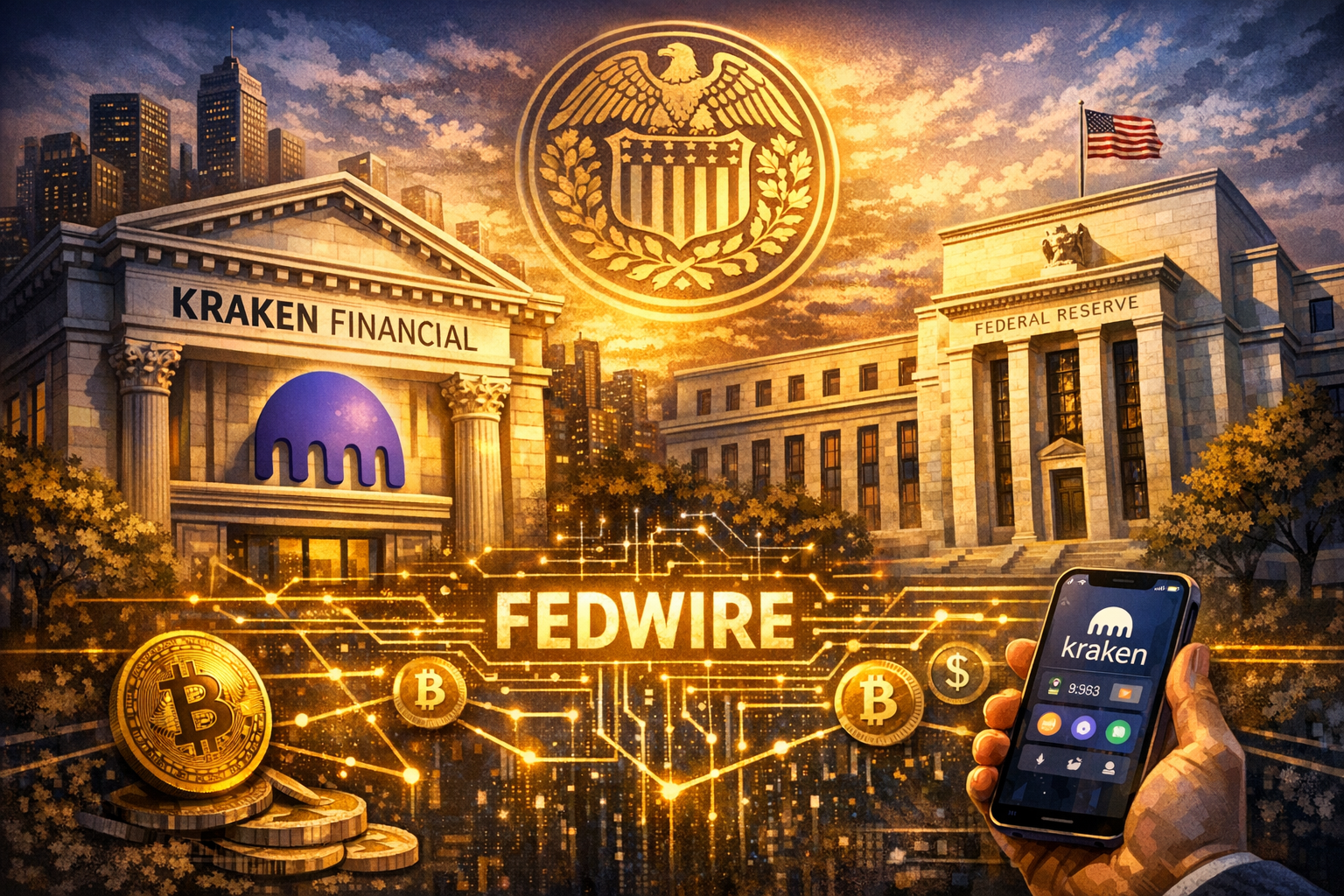
On March 4, 2026, Kraken Financial — the Wyoming-chartered banking arm of the Kraken exchange—was granted a Federal Reserve master account by the Federal Reserve Bank of Kansas City. That makes Kraken the first digital asset bank in U.S. history to receive direct access to the Federal Reserve's core payment infrastructure.
Let that sink in for a moment.
The same platform where millions of Americans buy Bitcoin and hold stablecoins can now settle transactions directly on Fedwire—the same payment rail the biggest banks in the country use. No intermediary. No correspondent bank. No middleman taking a cut and adding two business days to your money movement.
This isn't a press release milestone. This is a structural shift in American finance. And if you've been following the Make Your Wallet Your Bank thesis, you already know what comes next.
What a Fed Master Account Actually Means
Most people have never heard of a Federal Reserve master account, because most people have never needed to. It's the plumbing—the direct connection a financial institution gets to settle transactions across Fedwire, the backbone of the U.S. payments system.
Up until now, crypto exchanges had to route fiat through correspondent banks. That dependency created friction, cost, and a chokepoint the banking lobby was happy to maintain. Every wire, every ACH, every fiat on-ramp and off-ramp had to pass through a traditional bank that could—and sometimes did—close the account, slow the transaction, or simply decline to serve the client.
Kraken just cut that wire.
As Arjun Sethi, Co-CEO of Payward and Kraken, put it: “This milestone marks the convergence of crypto infrastructure and sovereign financial rails… we can operate not as a peripheral participant in the U.S. banking system, but as a directly connected financial institution.”
One important technical note: Kraken’s account is a limited-purpose, one-year account—sometimes referred to as a “skinny” master account—consistent with a framework the Federal Reserve has been developing for payments-focused, non-traditional financial institutions. It does not include interest on reserves, access to the Fed’s discount window, or the full suite of services available to traditional chartered banks. What it does include is something that has never before been granted to a digital asset institution: direct settlement on Fedwire. That is the historic part. And that is what the banking lobby immediately moved to attack.
The Banks Responded Within Hours. Read That Carefully.
Within hours of Wednesday’s announcement, three of the most powerful banking trade groups in Washington issued statements condemning the decision. Not days later. Not after deliberation. Within hours.
That is not the behavior of an industry that feels secure in its competitive position.
The Bank Policy Institute — which represents JPMorgan Chase, Bank of America, Wells Fargo, and Goldman Sachs—said it was “deeply concerned” that the approval came before the Federal Reserve finalized its policy framework, arguing that uninsured depository institutions present “substantially greater risks to the payment system.”
The Independent Community Bankers of America warned that the decision creates a two-tiered system in which crypto-focused institutions access payment rails without the same regulatory oversight applied to chartered banks.
The American Bankers Association’s Brooke Ybarra called it “another example of agencies taking significant action while the rules are still a work in progress,” adding: “This action puts the cart so far ahead, that the horse will never be able to catch up.”
There is a revealing subtext in all three statements. None of them argue that Kraken is technically unqualified. None point to a specific failure in Kraken’s operations or regulatory record. They argue about timing, process, and framework — the procedural tools of an industry that cannot win the substantive argument. When the banking lobby’s best counterargument is “the paperwork isn’t finished yet,” they have already conceded the field.
What they are really saying is this: if the Federal Reserve formalizes limited-purpose master accounts for payments-focused institutions, the competitive moat that has protected traditional banks for decades begins to drain. They are not wrong. That is precisely what is happening.
The cart is Kraken. The horse is the banks. If banks can’t catch up to the cart, then it’s because they continue to put profits over customers. When customers have options, they will chose the faster horse everytime.
Kraken Isn’t Just an Exchange Anymore — It’s a Better Bank
The banking lobby has spent years arguing that crypto exchanges are too risky, too unregulated, and too volatile to be trusted with real financial infrastructure. The Federal Reserve just disagreed—formally, and in writing.
But here’s what the banks don’t want you to notice: Kraken was already offering a better product.
Compare the security architecture of Kraken’s platform against what most traditional banks actually provide. The majority of legacy financial institutions still rely on username and password combinations fortified by SMS-based two-factor authentication—the same method security researchers have been warning against for years because of SIM-swap vulnerabilities. Though some larger banks are now finally in early-stages of adopting passkey adoption—finally! Traditional banks do not publish quarterly cryptographic proof that your deposits are actually there. They do not offer withdrawal address whitelisting with mandatory time-delay periods. And none of them have been operating under a full-reserve model that holds liquid assets equal to 100% of client deposits.
Kraken’s security stack includes:
• FIDO2-compliant passkeys with biometric authentication (fingerprint or Face ID), stored only on the user’s device — categorically resistant to phishing attacks
• No SMS or phone-based account recovery—deliberately engineered to eliminate SIM-swap attacks entirely
• Global Settings Lock (GSL) — a time-delay deadbolt that prevents any changes to account settings even if credentials are compromised
• Withdrawal address whitelisting with mandatory email confirmation and 72-hour delays for new addresses — meaning even a successful login cannot immediately drain funds to an unauthorized wallet
• Granular per-action 2FA — separate authentication required for login, trading, deposits, and withdrawals
• ISO/IEC 27001:2022 certification — the international gold standard for information security management
• Quarterly Merkle-tree Proof of Reserves audited by an independent accounting firm, with the September 2025 report confirming a 114.9% Bitcoin reserve ratio — meaning Kraken held more assets than it owed customers
https://theinvestorscentre.com/best-crypto-exchange/kraken-review/is-kraken-safe/
Kraken also carries a 13+ year track record with no customer funds ever lost to a security breach—an extraordinary record in a space where major competitors have suffered catastrophic failures. Its iOS App Store rating is 4.6/5 and 4.3/5 on Google Play. Users who complain do so about compliance friction and support response times—not about losing money.
Your bank publishes none of that. Because your bank cannot prove it.
This Is the First Domino, Not the Last
Kraken’s master account approval follows a deliberate, five-year regulatory engagement with the Federal Reserve and Wyoming supervisors. It was achieved through Kraken Financial’s status as a Wyoming Special Purpose Depository Institution (SPDI)—a full-reserve banking charter that requires liquid assets equal to or exceeding 100% of client deposits and strictly prohibits lending.
That’s right: Kraken Financial is legally required to operate more conservatively than most commercial banks, which borrow short to lend long and hold a fraction of deposits as reserves.
But make no mistake—Kraken won’t be alone for long. The moment regulators approved one digital asset institution for master account access, they created a blueprint every serious competitor will now follow. The trend line is clear: crypto exchanges are becoming neo-banks, and they are competing directly with the largest financial institutions in America for the everyday financial lives of consumers.
This matters enormously in the context of the GENIUS Act (which is law) and the CLARITY Act (which iscurrently moving through Congress). The banking lobby is simultaneously fighting Kraken’s Fed access and lobbying to eliminate stablecoin yield pathways at the centralized exchange layer. President Trump has already sided with the crypto industry on the stablecoin yield question, deepening the fault lines between legacy banking and digital asset infrastructure. These are not separate battles—they are the same war, fought on two fronts.
What This Means for the Make Your Wallet Your Bank Thesis
The core argument of Make Your Wallet Your Bank is simple: you don’t need a bank to be your bank. You need rails, security, and sovereignty over your own money.
For years, the weakest link in that argument was the fiat on-ramp and off-ramp. How do you move from dollars to stablecoins and back—without touching the traditional banking system? The answer was always: you can’t, quite yet. You still needed a bank account to fund an exchange, and a bank account to receive the proceeds.
Kraken’s Fed master account doesn’t eliminate that dependency entirely overnight. But it fundamentally restructures the power dynamic. A consumer who uses Kraken Financial as their primary financial institution can now:
• Hold fiat in a full-reserve, Fedwire-connected institution
• Convert to stablecoins on the same platform
• Access DeFi yield and programmable finance
• Convert back to fiat
• Settle directly on sovereign payment rails
Without touching a single traditional bank.
As Kraken’s Co-CEO explicitly identified as a near-term architectural goal, atomic settlement between fiat and crypto is coming. When it does, the friction that has kept consumers tethered to legacy banking dissolves entirely.
The Closing Argument
This is not a story about crypto getting lucky or regulators going soft. This is the predictable outcome of a well-capitalized, well-regulated digital asset institution doing five years of unglamorous work—regulatory engagement, operational audits, and sustained credibility-building. Kraken earned this.
The banking lobby’s immediate response is the most telling data point in this story. You don’t mobilize JPMorgan, Bank of America, Wells Fargo, Goldman Sachs, and the community banking associations within hours of an announcement unless you are genuinely threatened by what just happened.
They are threatened. And they should be.
Because if a crypto exchange can become a Fedwire-connected financial institution—operating on a full-reserve basis with a security architecture that surpasses anything legacy banking offers — then the question for American consumers is no longer can I trust crypto with my money?
The question is: why am I still giving my money to a bank?